Keep your customers informed during every incident
Launch branded public status pages and share real-time incident updates, scheduled maintenance, uptime history, and automated notifications — without enterprise complexity.
Reduce support tickets • Build customer trust • Stay transparent during outages
A simpler, faster alternative to StatusPage.io — built for startups and small teams.
No credit card required • Set up in under 5 minutes
Join startups and SaaS teams who value transparency
The real challenge
Communicating clearly during incidents
When service issues happen, customers look for a status page to get updates — and without one, confusion spreads.
Without a public status page, teams are forced to:
-
Handle repeated support tickets
- Your inbox fills with "Is the service down?" messages during every incident.
-
Share inconsistent updates
- Messages go out on Slack, email, Twitter — each with different information.
-
Leave customers guessing
- Users don't know what's affected, when it started, or when it will be fixed.
A public status page — with structured incident updates — prevents confusion and reduces repetitive support inquiries.
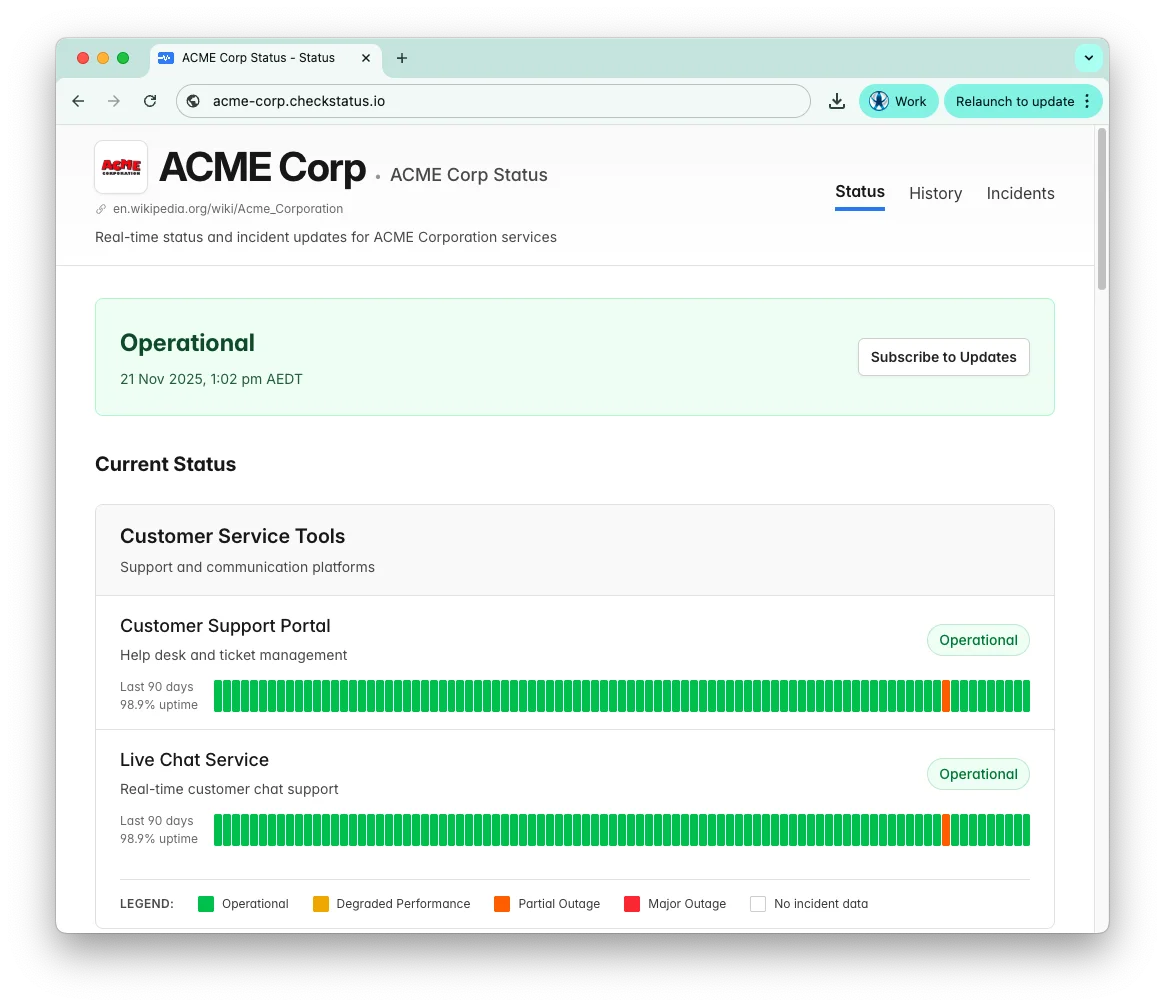
See CheckStatus in action
Experience a fully-featured demo status page showcasing real-time incident tracking, component monitoring, and uptime history.
Everything you need
Stay transparent with your customers
Everything you need to run a professional public status page and communicate incidents clearly.
-
Real-time incident updates
-
Create incidents in seconds and post updates as they evolve. Clear timelines with status changes keep everyone informed.
-
Service & component status
-
Define your services and show their operational status at a glance. Update component status independently during incidents.
-
Subscriber notifications
-
Let customers subscribe to updates. Automatic notifications when status changes — no manual follow-ups needed.
Built for modern teams
A status page that works the way you do
Simple to set up, powerful enough for any team. CheckStatus combines beautiful design with essential features.

- Custom domain & SSL.
- Use your own domain for a seamless brand experience. Automatic SSL certificates included.
- Email alerts.
- Automatically notify subscribers when incidents occur with beautiful email templates.
- Team collaboration.
- Invite team members, assign roles, and maintain clear audit logs of all changes.
- Private pages.
- Share internal status updates with your team only for internal stakeholder visibility.
- Scheduled maintenance.
- Announce planned maintenance ahead of time and close the loop once complete.
- Incident history.
- Maintain a public history of past incidents to build trust through transparency.
Why teams choose CheckStatus
Results that matter
- Reduce support load
-
Cut support tickets by up to 40% during incidents by giving customers a single source of truth.
- Build trust
-
Proactive updates show customers you care about transparency. Turn incidents into trust-building moments.
- Stay in control
-
Manage all incidents from one simple dashboard. No complex setup or configuration required.
- Launch in minutes
-
No coding required. Our simple setup wizard gets you live in under 5 minutes.
- On-brand design
-
Beautiful status pages that match your company perfectly with custom domains and branding.
- Professional features
-
Custom domains, SSL, API access, and team collaboration included in all plans.
Quick setup
Get started in 3 simple steps
- Create account
-
Sign up free and customize your status page appearance.
Takes 2 minutes
- Add components
-
Add your services and organize them into groups.
Takes 3 minutes
- Share with customers
-
Publish your status page and start building trust.
You're live!
Built for modern teams
Who uses CheckStatus?
- SaaS Companies
- Keep users informed about platform status and scheduled maintenance windows.
- Agencies
- Provide transparency to clients about service availability and planned maintenance.
- DevOps Teams
- Communicate infrastructure status across your organization and to external stakeholders.
Built by an engineer, for engineers
Why teams switch to CheckStatus
We built CheckStatus because existing tools were either too complex for small teams or too basic to be useful. Here's what makes us different.
Launch in minutes, not days
No complex onboarding flows or enterprise sales calls. Sign up, add your components, and share your status page — all in under 5 minutes.
Pricing that makes sense
Start free with no credit card. Paid plans start at $15/mo — a fraction of what enterprise tools charge. No per-seat pricing surprises.
Clean design, zero bloat
Your customers see a polished, branded status page. Your team gets a simple dashboard. No dashboards-within-dashboards or features you'll never use.
Pricing
Simple, transparent pricing
Start free, upgrade as you grow. No surprises.
Free
Perfect for getting started
$0 /month
- 1 Status Page
- 2 Team Members
- 50 Subscribers
- Real-time Updates
Starter
For small teams
$15 /month
- 1 Status Page
- 5 Team Members
- 500 Subscribers
- Real-time Updates
Growth
Popular
For growing teams
$39 /month
- 3 Status Pages
- 10 Team Members
- 1,000 Subscribers
- Real-time Updates
- Private Status Pages
Pro
For larger teams
$99 /month
- 10 Status Pages
- 100 Team Members
- 5,000 Subscribers
- Real-time Updates
- Private Status Pages
No credit card required • All plans include a 30-day free trial
FAQ
Frequently asked questions
-
A status page is a public webpage that shows the current operational status of your services. It allows you to communicate incidents, scheduled maintenance, and service health to your customers in real-time.
-
A status page builds trust through transparency, reduces support tickets during incidents, and provides a single source of truth for service health. Customers appreciate knowing what's happening without having to contact support.
-
Yes! Customers can subscribe to receive email notifications when incidents are created, updated, or resolved. They can also subscribe to specific components to only receive updates about services they care about.
-
Yes! You can use your own custom domain (like status.yourcompany.com) or a CheckStatus subdomain. SSL certificates are automatically provisioned and managed for all custom domains.
-
CheckStatus is designed for SaaS companies, startups, agencies, and DevOps teams who want a simple, professional status page without enterprise complexity. It's a simpler, faster alternative to StatusPage.io.
-
CheckStatus is focused on incident communication rather than monitoring. You manually create incidents and update component statuses. This gives you full control over what's communicated and when, and integrates with your existing monitoring tools via our API.
Ready to improve your incident communication?
Start your free trial today. No credit card required.
Join teams who value transparency